
Blog
Are Hypoallergenic Gold Hoops Actually Pure Gold?
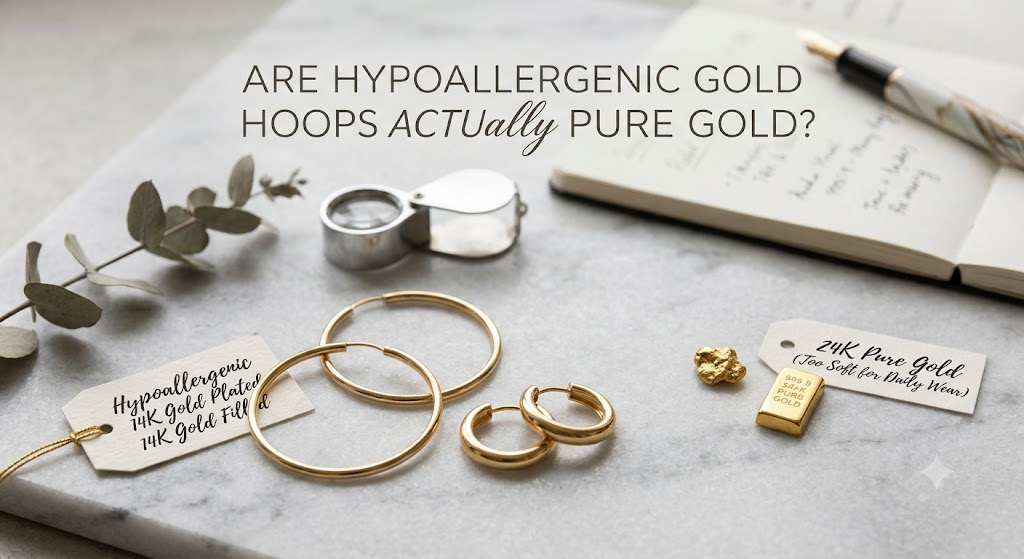
No — “hypoallergenic” and “pure gold” are two completely different claims, and a lot of shoppers assume they’re the same thing. Hypoallergenic simply means a piece of jewelry is formulated or plated to reduce the risk of an allergic reaction — usually by minimizing or eliminating nickel. It says nothing about how much actual gold is in the piece. You can have hypoallergenic jewelry that’s 18K solid gold, and you can have hypoallergenic jewelry that’s a base metal with a thin gold coating over the top. Both can honestly wear the “hypoallergenic” label.
If you’re shopping for small gold hoops specifically because your ears react to certain metals, understanding this distinction is the difference between buying something that actually solves your problem and buying something that just repeats the same issue with nicer marketing.
Why “Hypoallergenic” Isn’t a Purity Standard
Unlike karat marks (10K, 14K, 18K, 24K), which are legally regulated and must reflect a verified percentage of gold content, “hypoallergenic” is not a government-regulated term in the U.S. or most other countries. There’s no third-party body checking a manufacturer’s use of the word before it goes on a product listing. That means it functions more like a general reassurance — “this probably won’t bother your skin” — than a specific, checkable fact about what the earring is made of.
This is exactly why two totally different products can both use the word:
- A 14K solid gold hoop made without nickel in its alloy
- A brass or copper hoop plated in gold, with a nickel-free base metal underneath the plating
Both are technically “hypoallergenic” in that neither is likely to trigger a nickel reaction. But only one of them is solid gold, and that distinction matters a lot for how the earring performs over time.
What Actually Causes the Reaction in the First Place
Pure gold is chemically inert — it doesn’t oxidize, corrode, or react with skin. In fact, 24K gold (100% pure) is about as hypoallergenic as a metal gets. The problem is that pure gold is also very soft, too soft to hold its shape reliably in a piece of jewelry that gets handled, worn, and bumped every day. So manufacturers alloy it with other metals to add strength and durability.
That alloy is where the trouble usually starts. The most common culprit is nickel, a well-documented skin allergen used to harden gold alloys and, even more heavily, used in the base metals of gold-plated costume jewelry. Lower-karat gold (like 10K) contains a higher percentage of these alloy metals than higher-karat gold (like 18K), which is part of why 10K pieces are somewhat more likely to cause irritation in sensitive wearers.
Gold-plated jewelry raises the stakes further. The gold layer on top is often extremely thin, and normal wear — especially daily wear, moisture, and friction — gradually wears it away. Once that layer thins out, whatever metal is underneath (frequently a nickel-containing alloy) starts making direct contact with skin, which is often when reactions suddenly appear on jewelry someone has worn without issue for months.
So Is 24K Gold the “Most Hypoallergenic” Option?
Technically, yes — pure 24K gold contains no alloy metals at all, so there’s essentially nothing in it to react with. But in practice, 24K gold is rarely used for hoop earrings specifically, because its softness makes it prone to bending, scratching, and losing its shape with the kind of everyday handling hoops go through (putting them on, taking them off, brushing against hair and clothing).
Most jewelry marketed as “hypoallergenic gold” is actually nickel-free 14K or 18K gold — a middle ground that keeps enough gold purity to minimize reaction risk while retaining enough alloy strength to hold up as durable, wearable jewelry.
How to Actually Verify What You’re Buying
Because “hypoallergenic” alone doesn’t tell you much, the smartest approach is to check two things independently on any product listing:
- Karat purity — Look for an explicit stamp or stated karat (14K, 18K, etc.). If a listing only says “gold” or “gold-tone” with no karat mentioned, that’s a signal it’s likely plated or gold-filled rather than solid.
- Nickel-free claim, specifically — Some listings will explicitly state “nickel-free” separately from “hypoallergenic.” This is a more concrete, checkable claim than the general hypoallergenic label alone.
If a retailer clearly states both — for example, “14K solid gold, nickel-free” — you have a much stronger guarantee than a vague hypoallergenic tag by itself. If you have a diagnosed nickel allergy, it’s also worth asking the seller directly about the exact alloy composition before buying, since not every listing spells this out in detail.
What This Means If You Have Sensitive Ears
If you’ve had reactions to earrings in the past — redness, itching, swelling, or that telltale skin discoloration — here’s a practical hierarchy to shop by, from safest to riskiest:
- Best: Solid 18K or 14K nickel-free gold, or gold-over-titanium/surgical steel
- Good: Solid 14K gold (standard alloy, no explicit nickel-free claim, but higher purity than 10K)
- Riskier: Gold-filled or heavy gold vermeil (thicker plating than standard, but still not solid)
- Highest risk: Gold-plated costume jewelry, especially without a stated base metal
Notice that “hypoallergenic” as a label doesn’t actually appear as its own tier here — that’s the point. It’s a marketing signal worth taking as one data point, not a substitute for checking karat and composition yourself.
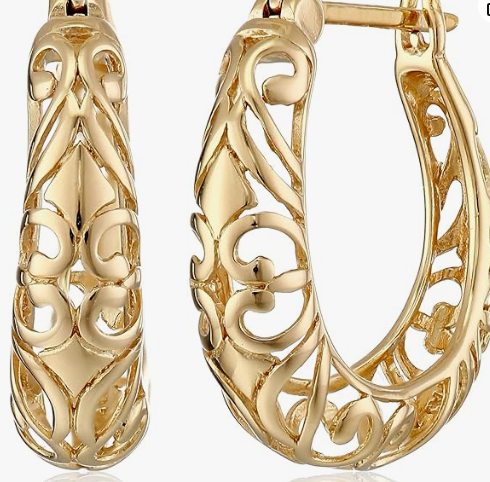
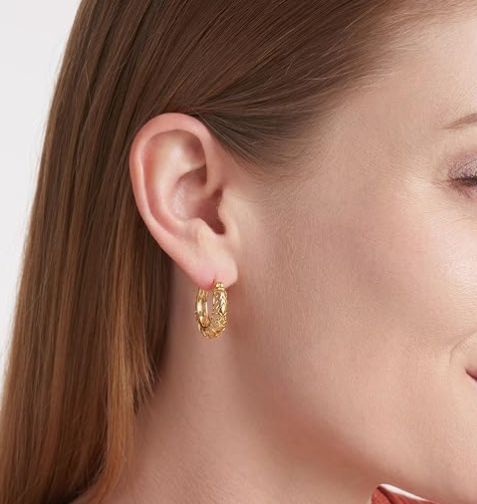
you can check this https://amzn.to/4iwQlQn
The Bottom Line
Hypoallergenic gold hoops are not automatically pure gold, and pure gold hoops aren’t always labeled hypoallergenic even when they’d qualify. The label is a helpful signal that a manufacturer has thought about sensitive skin, but it’s not a purity guarantee. If avoiding reactions is your priority, skip past the marketing language and go straight to the specs: karat purity and nickel content are the two things that actually determine whether a pair of gold hoops will be kind to your ears.
Frequently Asked Questions
Q: Is 24K gold the most hypoallergenic option for earrings? A: Yes, technically — pure gold has no alloy metals to react with. But it’s rarely used for hoop earrings because it’s too soft to hold up well to daily wear.
Q: Can hypoallergenic jewelry still be gold-plated rather than solid gold? A: Yes. Hypoallergenic plated jewelry uses a nickel-free base metal underneath the gold layer, but it’s still plated, not solid gold throughout, and the plating can wear thin over time.
Q: Does “nickel-free” mean the same thing as “hypoallergenic”? A: Not exactly. Nickel-free is a specific, checkable claim about composition. Hypoallergenic is a broader, unregulated marketing term that often (but not always) implies nickel-free.
Q: If I have a nickel allergy, is 14K gold safe for me? A: Standard 14K gold can still contain trace nickel in its alloy. Look specifically for 14K gold marketed as nickel-free, or consider 18K gold, which has an even lower alloy percentage.
Q: How can I tell if my current earrings are actually causing my irritation? A: If a dermatologist patch test isn’t an option, a good first step is switching to a verified nickel-free, higher-karat pair and seeing if the reaction stops — if it does, the metal composition was very likely the cause.
